

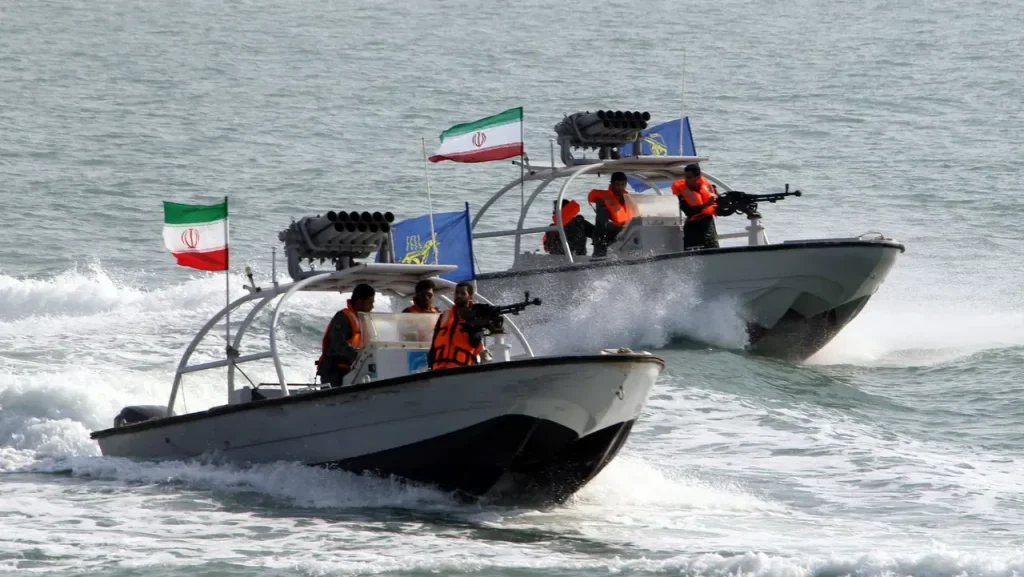
As tensions between the United States and Iran rise again, analysts point out that Iran’s real power at sea comes not from large warships, but from low-cost and difficult-to-detect asymmetric attack elements.
According to experts, at the heart of Iran’s ability to threaten commercial ships passing through the Strait of Hormuz is a multi-layered structure consisting of unmanned aerial vehicles, naval mines and small fast attack boats.
In military circles “mosquito fleet”These small boats, called , are used by the Iranian Revolutionary Guard Corps (IRGC). These boats, which are detected late in radar systems due to their small structure, can be equipped with missiles and heavy weapons.
Experts say this is more than a classic naval battle. “guerrilla war at sea”states that it means.
Sidharth Kaushal, a naval power expert from the Royal United Services Institute (RUSI), stated that the USA will have to maintain a concentrated military presence in a very wide area to protect commercial ships, and that this requires serious resources and costs.
IRAN’S STRATEGY CHANGED AFTER 1988
Iran’s small fast boat strategy has its origins in Gulf operations in 1988. At that time, the US army inflicted heavy losses on Iran’s conventional navy.
According to experts, after this experience, the Tehran administration invested in fast, cheap and easily renewable asymmetric elements instead of large warships.
Kaushal, “The traditional Iranian navy was more of a demonstration force. The structure of real strategic importance was the Revolutionary Guard Navy, which had asymmetric elements that were thought to be useful in war.”made his assessment.
MINES AND kamikaze drones
Analysts state that most of the attacks that have damaged commercial ships recently have been carried out with missiles and kamikaze drones. However, it is stated that the biggest fear is sea mines and fast attack boats.
According to the report of the Hudson Institute, Iran can even use civilian ships such as fishing boats in secret mine-laying operations. This makes safe ensuring maritime traffic in the region more complex.
While it is stated that the US Navy uses unmanned underwater vehicles to detect mines, experts point out that creating a safe passage corridor is an extremely time-consuming process.
STRATEGIC ADVANTAGE IN HORMIS
According to experts, one of Iran’s biggest advantages is its geographical location. There is no alternative route for the Strait of Hormuz, which is one of the most critical points in the world in terms of energy transportation.
Iran also deploys mobile anti-ship missile systems in hundreds of kilometers of mountainous and rocky areas along its southern coast. The mobility of these mobile systems further increases the threat to the United States.
Nick Childs of the International Institute for Strategic Studies (IISS), “The problem is that you can never be sure that all threats are completely blocked.”he said
“THERE IS NO NEED FOR IRAN TO HIT MANY SHIPS”
According to experts, Iran’s strategy is not to win a large-scale naval war; It is based on creating fear and cost pressure in global maritime trade.
Kaushal, “Iran does not need to attack many ships. It is enough to carry out enough attacks to scare insurance companies and ship owners.”made his assessment.
According to data from the United Kingdom Maritime Trade Operations Center (UKMTO), 26 ships have been the target of Iranian attacks in the Strait of Hormuz and the Persian Gulf since the start of the war.
US President Donald Trump announced that the operation to guide ships passing through the Strait of Hormuz has been temporarily suspended. However, it was stated that the blockade of Iranian ports will continue.
Iranian state media reported this decision “Failure of the USA”commented as.
On the other hand, while the Tehran administration is preparing new passage regulations for ships passing through the Strait of Hormuz, it plans to demand high fees in return for safe passage.
The US Treasury Department warned that companies making payments to Iran may face sanctions.
