

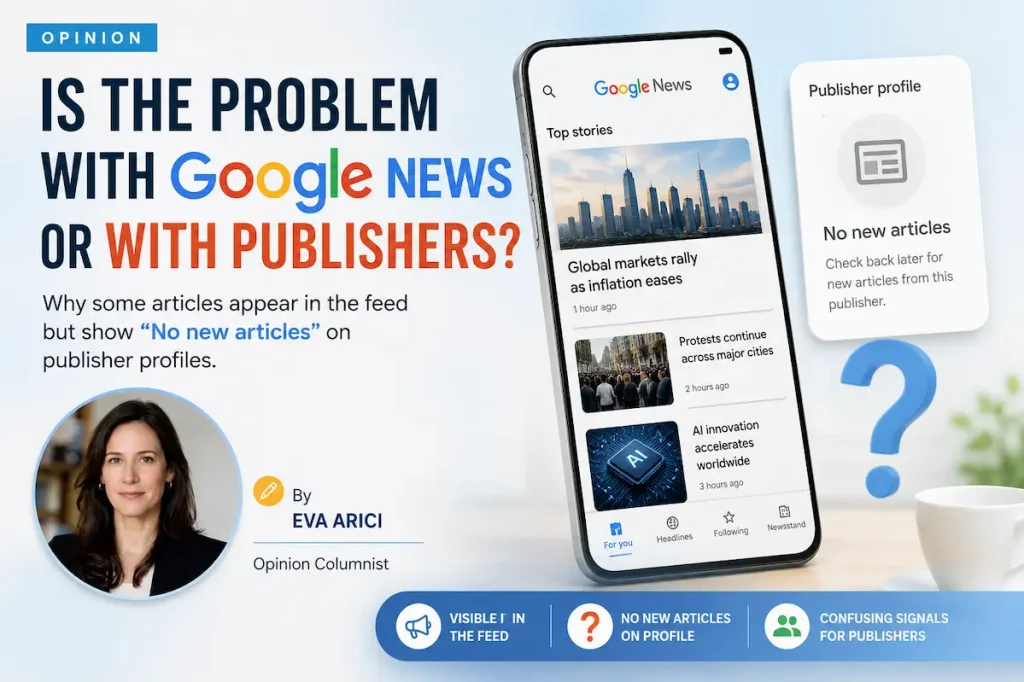
Google News has a considerable global audience and has become one of the most recognizable platforms in digital publishing. By bringing together content from various news organizations and delivering it to readers, it has positioned itself as a major gateway for online news consumption.
However, a long-standing inconsistency has raised questions for both publishers and readers: articles may appear in the Google News feed, while the same publisher’s profile page displays the message “No new articles.”
So, is the problem with the Google News app, or with publisher platforms?
Google News is widely regarded today as one of the most important traffic sources in digital journalism. Millions of users rely on the Google News app to follow current events, while thousands of news websites and publishers use the platform to monitor the visibility of their content.
Yet recent examples suggest that the Google News ecosystem may be creating a confusing experience for publishers.
In some cases, a publisher’s articles can appear in the Google News feed, while the publisher’s own profile page shows the warning “No new articles.” At first glance, this may seem like a minor technical detail. For independent publishers, however, it can create serious uncertainty.
The situation naturally raises several questions:
Why does a publisher profile say “No new articles” if the articles are visible in the Google News feed?
Which screen should publishers trust?
Has the content reached the system, or has it not?
Is this a software bug, or is it part of a different operating logic within Google News?
For publishers that regularly produce news, update their Google News sitemaps and meet technical requirements, such contradictory signals can be deeply confusing.
A publisher may interpret the “No new articles” message on the profile page as a sign that their content is not being seen. Yet at the same time, those articles may already be visible in the Google News feed.
What makes the issue even more notable is that it does not appear to be limited only to small or newly established publishers. Similar cases can occasionally be seen on the profiles of larger news organizations as well. This raises the possibility that the issue may not be solely related to publisher-side technical problems.
Google News has become one of the key platforms in the global discovery and distribution of news. A system with such influence is expected to provide clear, understandable and consistent information to both readers and publishers.
When articles are visible in one part of the platform, but the same source is shown with a “No new articles” message elsewhere, it creates a contradiction that needs to be explained from a user experience perspective.
Of course, the reason may involve caching, data synchronization, app updates or the internal operating structure of Google News. But from the user’s point of view, the result remains the same: different screens inside the same platform can deliver conflicting messages.
At a time when trust and transparency in digital publishing matter more than ever, it is also vital for publishers to receive accurate signals from the platforms they depend on.
That is why the central question remains unanswered:
Is the problem with the Google News app, or with publisher platforms?
