


Protests, Nuclear Messaging and Regime Resilience Analysis Through the 47th Anniversary Ceremonies
Introduction: A Dual-Layered Political Reality
As of early 2026, two parallel and complementary processes stand out in Iranian politics. The first concerns deepening debates over domestic legitimacy, shaped by protests, economic pressures, and representation crises. The second involves messages of resistance and sovereignty directed toward the outside world through revolutionary anniversary ceremonies, military rhetoric, and emphasis on nuclear sovereignty.
While the president’s statement that Iran does not seek nuclear weapons and his relatively softer tone regarding protests signal an effort to maintain social balance, the ideological rhetoric and military displays during the 47th anniversary ceremonies demonstrate continued firmness in foreign policy discourse.
1. Domestic Politics and the Search for Legitimacy: Discursive Defense After the Protests
The latest wave of protests has revealed that the Iranian leadership has adjusted not only its security posture but also its rhetoric. The president’s self-critical remarks suggest limited awareness among regime elites; however, this approach should be interpreted more as crisis management than systemic transformation.
The fact that protests extend beyond economic demands to include lifestyle and political representation issues reinforces the structural nature of social unrest. The gap between opposition narratives emphasizing erosion of social support and official media rhetoric stressing unity forms the core of Iran’s political narrative competition.
Pro-regime mobilization
-
Shaped by state organization, ideological loyalty, and security perception.
-
Participation largely occurs through institutional networks and symbolic allegiance.
Anti-regime protests
-
More fragmented and spontaneous.
-
Often triggered by economic or cultural grievances.
-
Organized through social media and local networks.
This comparison does not suggest a fully polarized society. Rather, it reveals a fragmented legitimacy map. While the regime preserves its core support base, it experiences erosion among urban and younger populations. Occasional rhetorical softening should therefore be viewed not as systemic reform but as an effort to contain legitimacy loss.
2. Revolutionary Rituals and Mobilization: The Political Function of the 47th Anniversary
The anniversary marches and 22 Bahman rallies are not merely historical commemorations; they function as mechanisms for reproducing the regime’s revolutionary identity. Anti-Israel slogans, anti-US representations, and mass mobilizations can be understood as performative politics staging ideological continuity.
Amid economic crisis and protest intensity, these ceremonies serve as a “legitimacy demonstration,” showcasing the regime’s mobilization capacity. However, given that part of participation is driven by state organization and institutional mobilization, these events cannot be interpreted as direct indicators of broad societal consent. Instead, they should be analyzed primarily as political performance and strategic communication instruments.
3. Nuclear Discourse and Military Signaling: A Dual-Message Strategy
When Iran’s nuclear rhetoric is assessed alongside the military messaging displayed during revolutionary ceremonies, a multi-layered deterrence strategy becomes evident.
While the president’s emphasis that Iran does not seek nuclear weapons signals diplomatic flexibility, the defense of uranium enrichment rights and the declaration that the ballistic missile program is “non-negotiable” define sovereignty boundaries.
This approach produces a threefold message:
-
Domestic audience: The revolution’s military achievements are safeguarded.
-
Regional actors: Deterrence toward Israel and Gulf states.
-
Global diplomacy: A bargaining framework for potential talks with the United States.
Thus, military displays and nuclear rhetoric go beyond propaganda; they constitute integral components of negotiation strategy.
4. Symbolic Enemy Construction, Propaganda and the International Perception War
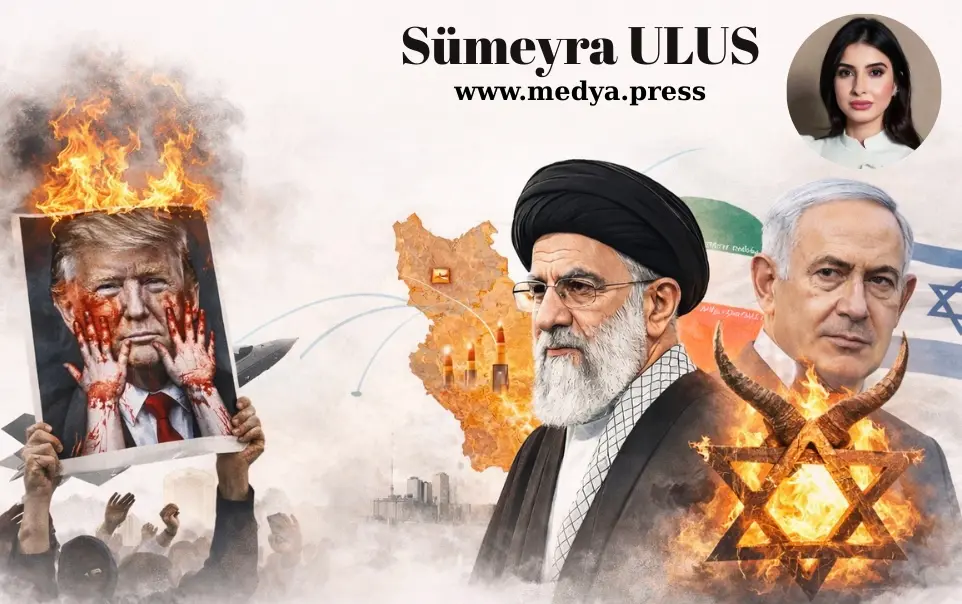
Acts such as burning Trump effigies or Israeli symbols represent more than classical propaganda; they function as ritualized political theater. While such performative enemy construction generates emotional mobilization domestically, it also reinforces Iran’s image as an uncompromising actor in international media narratives.
Western media highlight protests and social tensions, whereas Iran’s official discourse emphasizes national unity and external threats. This dual narrative structure reflects the media dimension of geopolitical competition.
The 47th anniversary ceremonies coincided with ongoing Iran–Israel tensions and limited diplomatic engagement with the United States. Therefore, these events should be read not only as ideological commemorations but also as geopolitical signaling arenas.
Conclusion: Regime Resilience and Multi-Layered Political Performance
As of 2026, two simultaneous trends characterize Iranian politics. Domestically, economic pressure and protests deepen legitimacy debates; externally, revolutionary ceremonies, military rhetoric, and nuclear sovereignty discourse reinforce a narrative of regime resilience. The contrast between the president’s occasionally softened rhetoric and the hard ideological performance during official ceremonies illustrates the multi-layered structure of Iranian politics.
When pro-regime mobilization and anti-regime protests are evaluated together, the picture that emerges points neither to total societal rupture nor to full ideological cohesion. Rather, it indicates a political structure that preserves its core loyalty while experiencing contraction in its peripheral support base.
In the coming period, political stability will depend on economic reform capacity, elite balance, regional security architecture, and the trajectory of nuclear negotiations. Revolutionary rituals and nuclear discourse will likely continue to function as key instruments for managing internal legitimacy crises and strengthening leverage in foreign policy bargaining.
Sources
-
Deb, Kushal. “Iranian demonstrators torch ‘Baal’ statue in 47th Islamic revolution anniversary and chant ‘death to Israel’.” WION, 12 Feb. 2026.
-
Al Jazeera Staff and News Agencies. “Iran says missile programme non-negotiable as Tehran, Washington eye talks.” Al Jazeera, 11 Feb. 2026.
-
Borger, Julian. “Iran president denies it seeks nuclear weapon, admits shame after protests.” The Guardian, 11 Feb. 2026.
-
“BBC’nin Tahran izlenimleri: ‘Devrim mitingleri, isyanın gölgesinde kaldı’.” BBC News Türkçe, 11 Feb. 2026.
-
Iran International. “Iran marks 1979 anniversary under deepening legitimacy strain.” 9 Feb. 2026.
-
Mehr News Agency. “22 Bahman turnout sends defiant message to Iran’s foes.” 10 Feb. 2026.
-
Mehr News Agency. “Iran has right to enrich uranium as NPT member.” 10 Feb. 2026.